
The hard part of mental health care is often memory. A full-time clinician sees thousands of encounters a year: trials, life events, symptom patterns, what actually helped. Nobody holds all of that in working memory. The cost is repeated questions, late interventions, and a covering clinician who is guessing.
AI is useful here when it builds a patient timeline, keeps the events that change the plan, and lets the practice see the same history the primary clinician thinks they remember.
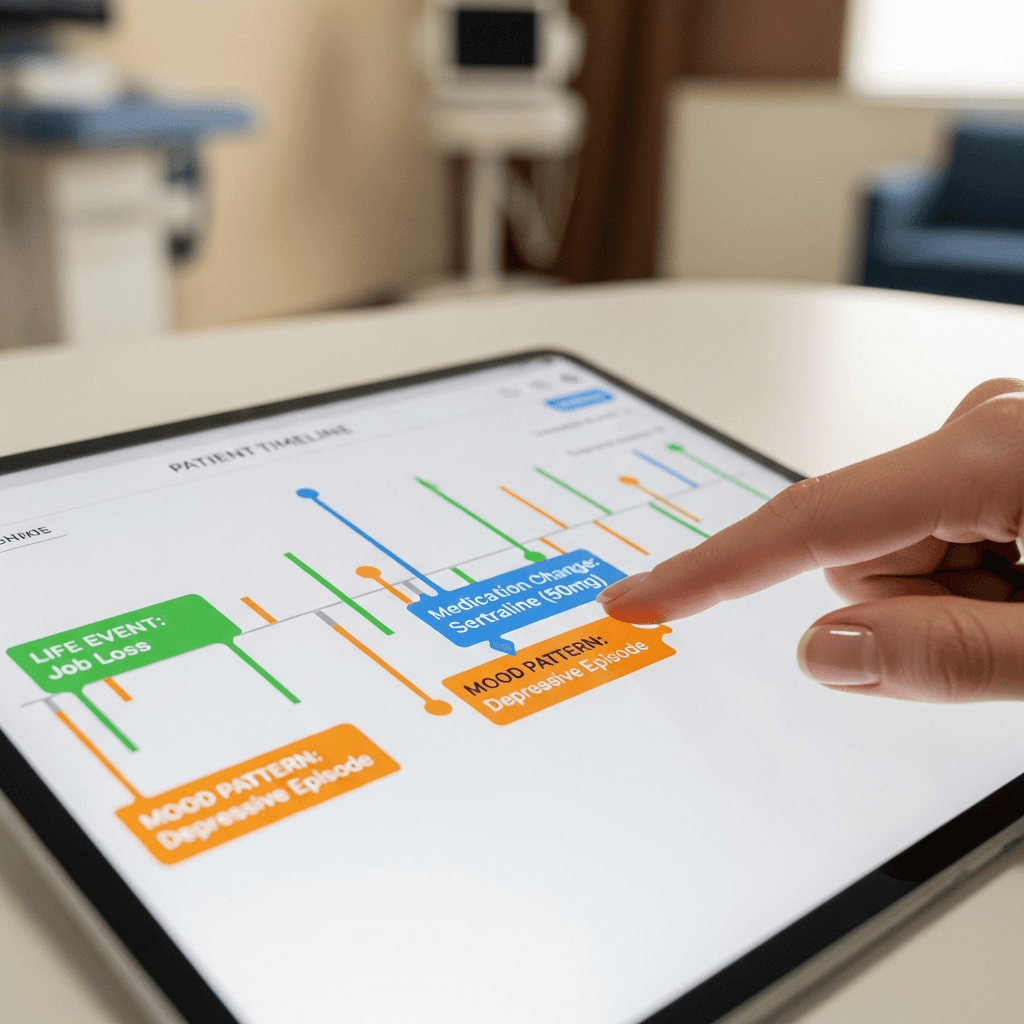
Life events that belong on the next visit
AI can pull significant events out of the notes and surface them when they matter again. A September visit about coping can show that last September was the anniversary of a trauma. Elevated mood in early summer can sit next to three prior summers that included hypomania.
That is empathy you can schedule: you did not forget what they already told you. It is also diagnosis. Current symptoms get a history instead of a blank slate.
You spend the visit with the person, not rereading last March in the middle of the hour.
Cross-coverage
A covering clinician walks in cold: no feel for baseline, past responses, or risk. That produces defensive medicine, the same history taken twice, and the warning sign only the usual prescriber would have caught.
A timeline that opens in a minute should show medication history with responses and side effects, recent risk, how they decompensate, current stability, pending labs or open tasks, relevant social context, and symptom trend. The patient should not have to re-explain the last two years because you are on call. The practice also reduces the liability of a coverage night where the dangerous fact lived in someone else’s head.
Instability before it is a crisis
The useful read is change across visits: rising irritability, sleep disruption, slipping adherence, early activation, a downshift in mood, more PTSD symptoms, or a rising chance of substance relapse.
Sleep plus mild irritability can be a dose conversation. Waiting for mania can be a hospitalization. Experienced clinicians do this from familiarity. A timeline does it for the person who has never met the patient.
Eligibility for the next step
The same memory can watch for criteria: treatment-resistant depression that may meet esketamine (Spravato) rules, depression still present after adequate trials that may warrant TMS, recurrent severe depression that may need an ECT conversation, response patterns that suggest pharmacogenetic testing, or a protocol such as TMS for bipolar depression.
Two adequate antidepressant-class trials without a response is the moment to raise Spravato or TMS, not the moment after you have tried every remaining oral option from habit.
The panel, not only the patient
Practice-level views find people overdue for metabolic labs, at higher relapse risk, possibly eligible for advanced treatment, or lost to follow-up. They also show which meds work in this clinic, which side effects stall care, and how long stabilization usually takes in each diagnosis. That is how you staff, how you write a protocol, and how you talk about quality in a value-based contract, instead of arguing from the last case you remember.
Transitions
Patients move, switch clinicians, leave, and come back years later. A timeline that survives those breaks means the new clinician starts from the record, not from a first-visit fiction. Whether they return after five years or switch inside the group, the treatment history should still be there. Continuity stops depending on one person’s memory.